
Flexible funding solutions for residential, commercial, and mixed-use projects
From small-scale builds to large-scale projects, we secure the funding you need to bring your vision to life
Ready to Discuss Your Project?
Get expert guidance on the right funding mix for your next project.
What Is Development Finance?
Development finance is a specialised form of lending designed to fund the construction, renovation, or subdivision of property. Unlike a standard home or investment loan, it’s tailored to the unique cash flow requirements of a project – from land acquisition through to completion and sale.
Whether you’re building a single dwelling, a townhouse complex, or a large mixed-use development, the right structure ensures your project progresses smoothly without unnecessary financial strain. Development finance can cover part or all of your project costs, including site purchase, construction expenses, and interest capitalisation, depending on the lender and risk profile.
A well-structured loan doesn’t just provide funds – it aligns repayments with your build timeline, manages risk, and allows you to maintain working capital for other ventures.

Residential vs Commercial Developments
Residential Development
Commercial Development
Residential development finance typically applies to smaller-scale projects such as duplexes, townhouses, or apartment blocks intended for sale or investment. These loans often focus on pre-sales, build costs, and end-value to determine funding limits.
Commercial development finance, on the other hand, is suited to projects like offices, warehouses, retail complexes, or mixed-use sites. These transactions involve more complex feasibility studies and may include multiple revenue streams such as lease pre-commitments or anchor tenants.
Residential projects are generally assessed on market demand and pre-sales.
Commercial projects rely more on tenancy strength and long-term yield potential.
Residential Development
Residential development finance typically applies to smaller-scale projects such as duplexes, townhouses, or apartment blocks intended for sale or investment. These loans often focus on pre-sales, build costs, and end-value to determine funding limits.
Residential projects are generally assessed on market demand and pre-sales.
Commercial Development
Commercial development finance, on the other hand, is suited to projects like offices, warehouses, retail complexes, or mixed-use sites. These transactions involve more complex feasibility studies and may include multiple revenue streams such as lease pre-commitments or anchor tenants.
Commercial projects rely more on tenancy strength and long-term yield potential.
How Development Finance Differs from Traditional Loans
Development Finance
Traditional Finance
Development finance, by contrast, is structured for flexibility and project milestones.
Traditional property loans are structured for stability fixed repayments over time based on income or rental return.
Funds are typically released in staged drawdowns aligned with construction progress, with interest charged only on the amount drawn.
Funds are usually released as one full loan amount at settlement. Interest applies to the full balance from day one.
Many lenders also allow interest capitalization, meaning repayments are deferred until project completion or settlement of sales.
Borrowers are generally required to make monthly interest or principal-and-interest repayments during the loan term.
The assessment process is more detailed too, often involving feasibility reports, builder experience, cost schedules, and end valuations.
The assessment process is more general and usually focuses on income, credit, and property value.
While it’s more complex than a standard mortgage, the right structure provides greater control, reduces holding costs, and improves cash flow throughout the build.
Traditional loans are simpler, but they provide less flexibility for project-based funding and can increase holding costs.
Traditional property loans are structured for stability — fixed repayments over time based on income or rental return. Development finance, by contrast, is structured for flexibility and project milestones.
Funds are typically released in staged drawdowns aligned with construction progress, with interest charged only on the amount drawn. Many lenders also allow interest capitalisation, meaning repayments are deferred until project completion or settlement of sales.
The assessment process is more detailed too, often involving feasibility reports, builder experience, cost schedules, and end valuations. While it’s more complex than a standard mortgage, the right structure provides greater control, reduces holding costs, and improves cash flow throughout the build.
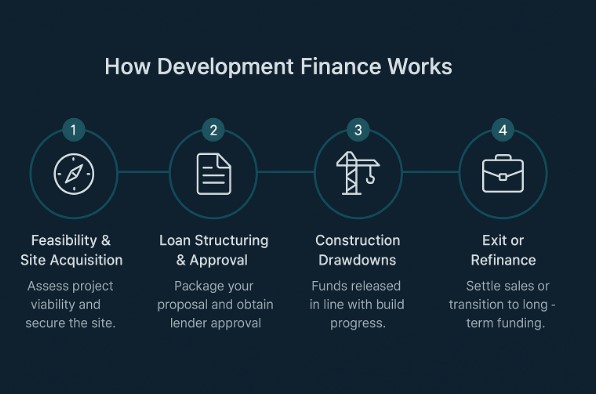
How Development Finance Works
Development finance is structured to mirror the natural life cycle of a project — from feasibility and land purchase through to construction, completion, and sale. Unlike a traditional loan that releases all funds upfront, development funding is typically advanced in stages, giving both lenders and developers tighter control over risk, cost, and timing.
Each stage is assessed against verified milestones, ensuring funds are released only when value has been added to the project. This staged structure protects the lender’s position while allowing the developer to focus on execution rather than juggling multiple financing sources.
Understanding how each phase of funding fits into the overall structure is crucial — it determines how smoothly your project runs, how efficiently capital is deployed, and ultimately how profitable the end result will be.
Feasibility & Site Acquisition Funding
Every successful project begins with a solid feasibility assessment. Before a lender advances funds, they want to see evidence that the project is commercially viable and well planned. This includes detailed cost estimates, projected gross realisation value (GRV), market demand analysis, and a clearly defined exit strategy.
During the site acquisition stage, developers may access specialised acquisition or bridging finance to secure land before full approvals or pre-sales are in place. These short-term loans are typically assessed against the site’s purchase price, location, and development potential rather than existing income.
Once feasibility is complete and planning approvals are progressing, the acquisition facility can often be rolled into a larger development or construction facility. This seamless transition reduces time between purchase and commencement — crucial in competitive markets like Sydney, Melbourne, and Brisbane where holding costs can quickly erode returns.
Professional feasibility reports prepared by qualified valuers or quantity surveyors not only strengthen the funding proposal but can also improve the lender’s confidence in project delivery. In many cases, a well-presented feasibility package is the difference between a declined application and a fully funded project.


Construction Drawdowns & Progress Payments
Once the project is approved and construction commences, funds are released progressively through staged drawdowns. Each stage – typically base, frame, lock-up, and completion – is verified by an independent quantity surveyor or valuer before payment is made to the builder.
This approach ensures that funds are only released once real, measurable progress has been achieved on-site. It protects both the lender and the developer by maintaining a direct correlation between project value and loan exposure at all times.
Interest is generally charged only on the funds drawn, meaning you’re not paying for capital you haven’t yet used. For larger projects, interest capitalisation can also be built into the facility, allowing repayments to be deferred until settlement of sales or project completion.
Many lenders will also consider funding GST, contingency, or soft costs such as marketing and professional fees within the overall facility limit. This holistic funding structure helps keep your working capital free for other commitments and reduces the need for multiple financing sources.
Having a broker experienced in construction finance is essential during this phase. They coordinate drawdown requests, liaise with valuers, and ensure progress claims are processed quickly – preventing costly delays to your build schedule.
Exit Strategies & Refinancing Options
Every development facility must have a clearly defined exit strategy — how the loan will be repaid once construction is complete. This may involve:
Selling completed dwellings or commercial units (using settlement proceeds to repay the facility),
Refinancing into a long-term investment or residual stock loan, or Securing takeout finance from a mainstream lender once presales or leases are finalised.
An effective exit strategy is a cornerstone of a strong funding proposal. Lenders assess not just the end value of the project, but also how realistic and timely the repayment pathway is. The more predictable your exit, the sharper your pricing and leverage options will be.
In some cases, developers may also use refinancing to transition from high-cost, short-term construction funding into a lower-rate investment facility once the project stabilises. This is common for mixed-use or commercial assets where the developer chooses to hold rather than sell.
Engaging your broker early ensures your exit pathway is mapped from the outset — avoiding rushed decisions near completion and ensuring funding transitions align perfectly with your sales or leasing timeline.

Ready to Discuss Your Project?
Get expert guidance on the right funding mix for your next project.
Types of Development & Construction Funding
Construction Finance
For builders, small developers, and owner-builders.
Multi-Unit Development Finance
Townhouses, apartments, mixed-use projects.
Land Subdivision Finance
For land-only or staged projects.
Residual Stock Loans
For unsold units post-completion.
Ready to Discuss Your Project?
Get expert guidance on the right funding mix for your next project.

Mezzanine Finance & Preferred Equity
As projects grow in size and complexity, traditional senior debt alone often isn’t enough to complete the capital stack. That’s where mezzanine finance and preferred equity come in — flexible funding options designed to bridge the gap between the developer’s equity and the primary lender’s facility.
These structures are popular among experienced developers who want to maximise leverage, preserve cash flow for future projects, or fast-track developments that would otherwise stall due to capital constraints. Mezzanine finance sits between senior debt and equity in the funding hierarchy, providing additional capital without requiring the developer to sell down ownership or control.
Because mezzanine funding is higher risk than first mortgage lending, it attracts a higher rate of return but offers significant advantages in speed, structure, and scalability when used strategically.
What Is Mezzanine Finance?
Mezzanine finance is a form of secondary funding secured behind the primary lender. It’s typically structured as a second mortgage or a caveat loan, allowing developers to access additional funds once their senior debt limit has been reached.
For example, if a first mortgage lender offers funding up to 65% of the Gross Realisation Value (GRV), a mezzanine facility might extend total funding up to 80–85% of GRV. The developer contributes less upfront equity while maintaining full control over the project and its profit margins.
Mezzanine lenders are generally private investors, family offices, or specialist funds that assess the project’s feasibility, location, and borrower experience rather than relying solely on traditional income verification. This makes mezzanine finance particularly valuable for developers managing multiple projects or those needing fast access to capital without lengthy bank processes.
Interest is often capitalised over the project term and repaid from sales or refinance proceeds at completion, meaning no monthly repayments are required during construction. This keeps working capital free and simplifies cash flow management.

What Is Mezzanine Finance?
Mezzanine finance is best used when:
The developer has a strong track record but wants to reduce personal equity contribution.
The senior lender won’t extend leverage beyond a certain limit (usually 65–70% of GRV).
A project requires rapid settlement or bridging between stages of funding.
The developer wishes to retain ownership rather than bringing in joint-venture partners.
Typical loan-to-value ratio (LVR) structures look like this:
Senior Debt: Up to 65–70% of GRV (first mortgage)
Mezzanine Debt: Additional 10–15%, bringing total exposure to 80–85% of GRV
Developer Equity: Remaining 15–20%
In some cases, preferred equity is used instead of or alongside mezzanine funding. This acts more like an investment stake offering returns through profit participation rather than fixed interest while still ranking ahead of common equity in repayment priority. It’s ideal for larger or multi-stage projects where flexibility and partnership alignment are more important than strict debt structures.
Benefits for Developers & Lenders
Mezzanine finance offers substantial advantages to both developers and lenders when structured correctly.
The key to success is ensuring all parties’ interests align that the senior lender, mezzanine funder, and developer are working toward a shared outcome with transparent documentation and clear intercreditor agreements.
For developers, it provides the ability to:
- Increase leverage – Access higher total funding with a smaller equity contribution, freeing capital for other opportunities or contingency reserves.
- Retain ownership and control – Unlike equity partnerships, mezzanine funding doesn’t dilute ownership or decision-making authority.
- Accelerate timelines – Secure fast capital injections to meet settlement deadlines or begin construction sooner, reducing holding costs.
- Smooth cash flow – Interest is often capitalised, meaning no ongoing repayments during the build phase, improving liquidity and reducing financial stress.
- Boost return on equity – By minimising the initial outlay, developers can achieve higher percentage returns when the project is successfully completed and sold.
For lenders and investors, mezzanine finance presents:
- Attractive risk-adjusted returns – Typically higher yields than senior debt, backed by tangible security in the form of a second mortgage or caveat.
- Structured downside protection – Senior lenders still hold first position, but mezzanine facilities are underpinned by clear feasibility data, pre-sales, and exit strategies.
- Diversified exposure – Investors gain access to quality projects without assuming the full risk profile of development equity.
Alternatives: Preferred Equity & Joint Venture Funding
When mezzanine debt isn’t the ideal fit for example, when leverage limits have already been reached or when the developer seeks a partner rather than a loan preferred equity or joint venture (JV) structures can offer flexible alternatives.
Preferred Equity
Preferred equity sits between mezzanine debt and common equity in the capital stack. Instead of fixed interest payments, preferred equity investors receive a pre-agreed return often a combination of a base coupon and a share of project profits.
This structure appeals to developers who:
- Want to avoid second mortgages or high interest costs.
- Are comfortable sharing a portion of profit in exchange for non-recourse capital.
- Need flexible repayment options that adapt to project outcomes.
Preferred equity investors, meanwhile, gain the benefit of enhanced returns and priority repayment ahead of standard equity holders but after debt providers — balancing reward and risk effectively.


Joint Venture (JV) Funding
In a joint venture, a capital partner contributes equity in exchange for a negotiated profit share or ownership stake in the completed project. This option is ideal for developers with strong deal flow but limited capital reserves or for large-scale developments requiring multiple funding layers.
While JVs typically involve more negotiation and shared decision-making, they can unlock larger projects and reduce financial exposure for the developer. For investors, joint ventures provide direct participation in development upside — often with the developer acting as project manager or delivery partner.
Ready to Discuss Your Project?
Get expert guidance on the right funding mix for your next project.
Development Loan Structure & LVRs
A well-designed loan structure is the foundation of any successful development project. It dictates how much funding can be accessed, how and when it’s released, and what conditions apply throughout the build.
Lenders assess several key factors including the project’s end value, cost-to-complete, and presales to determine overall risk and borrowing capacity. Understanding these mechanics helps developers plan confidently, manage cash flow, and avoid unexpected funding shortfalls mid-project.
At its core, a development facility is about balance: aligning funding with progress, maintaining adequate equity in the project, and ensuring the lender remains protected while the developer maintains control.


Typical Loan-to-Value Ratios (LVR) and Cost-to-Complete
Most lenders structure development loans based on a combination of the project’s Loan-to-Value Ratio (LVR) and Loan-to-Cost (LTC) metrics.
For first mortgage lenders (banks and private funders), typical maximum exposures are:
- 65–70% of Gross Realisation Value (GRV) – calculated on the completed value of the project.
- 75–85% of Total Development Cost (TDC) – depending on the borrower’s experience, location, and project type.
Private or non-bank lenders may stretch slightly higher for well-presented projects, while banks tend to remain conservative. Developers are usually required to contribute the remaining 15–30% as equity, either through cash, land value, or project pre-sales.
The cost-to-complete ratio ensures the project always has enough unutilised loan funds to finish construction. Lenders track this closely throughout drawdowns to confirm the remaining undrawn facility is sufficient to complete the build, regardless of market changes or unforeseen cost increases.
A strong loan structure keeps this ratio within safe limits — providing confidence to both lender and developer that the project can be delivered on time and within budget.
Pre-Sales & DA/BA Requirements
Before approving funding, most lenders require a combination of planning approvals and evidence of market demand.
Development Approval (DA)
Building Approval (BA)
Pre-Sales
The required level of pre-sales varies by lender and project type. Typical expectations are:
- Residential Projects: 60–80% of total debt covered by pre-sales.
- Commercial Projects: May rely more on pre-leases or valuation-based assessments rather than presales.
However, private lenders and specialist funds can offer low or no presale options for strong borrowers, experienced developers, or well-located projects — often at slightly higher rates in exchange for flexibility and speed.
Having DA and BA approvals, a detailed feasibility study, and a clear exit strategy all help reduce perceived risk, resulting in sharper pricing and smoother approvals.
Serviced vs Capitalised Interest Options
Another key element in structuring a development facility is how interest is managed throughout the project. Lenders typically offer two approaches:
Lenders assess which structure is most appropriate based on total project costs, feasibility strength, and borrower experience. In many cases, a hybrid approach — partial capitalisation with early-stage interest servicing — can optimise both liquidity and lender comfort.
The right interest structure not only supports smoother project delivery but also safeguards profitability by preventing unnecessary financial pressure during the build phase.
1.
Serviced Interest
In a serviced structure, interest is paid monthly throughout the loan term. This option suits developers with strong cash flow or projects generating income during construction (such as staged developments or partial leasebacks). Servicing interest as you go can sometimes reduce total facility size and improve lender confidence.
2.
Capitalised Interest
Capitalised interest allows the developer to defer repayments until completion, with all interest costs funded within the facility itself. This structure improves cash flow and simplifies budgeting by consolidating holding costs into the overall loan amount. It’s especially common in residential or speculative developments where income doesn’t commence until sales settle.
Ready to Discuss Your Project?
Get expert guidance on the right funding mix for your next project.
Why Partner with Balmoral Finance
At Balmoral Finance, we specialise in connecting property developers and builders with the right funding solution — fast, flexible, and tailored to every stage of your project. Our experience, network, and transparent approach set us apart in an increasingly complex lending landscape.
Expertise in Development & Construction Lending
With extensive experience across residential, commercial, and mixed-use projects, our team understands the technical, financial, and timing pressures developers face — ensuring your loan structure supports delivery, not delays it.
Access to Bank & Private Funding Channels
We maintain strong relationships with major banks, non-bank lenders, and private funders nationwide. This allows us to negotiate competitive terms and secure funding even when traditional lenders fall short.
Nationwide Reach, Local Insight (Sydney-Based)
Headquartered in Sydney, we deliver finance solutions across Australia — combining national market reach with deep local knowledge of planning, valuations, and lender appetite.
Fast Turnaround & Transparent Communication
We pride ourselves on responsiveness and clarity. From initial consultation to settlement, you’ll have direct access to senior decision-makers who keep you informed every step of the way.
Ready to Discuss Your Project?
Get expert guidance on the right funding mix for your next project.
Recent Projects Funded
Frequently Asked Questions
What is the typical LVR for development finance?
- Typical Loan-to-Value Ratios (LVRs) for development finance range between 65% and 70% of the project’s Gross Realisation Value (GRV) for senior debt. Some non-bank and private lenders may extend higher, particularly for experienced developers or lower-risk locations.
- When mezzanine finance or preferred equity is layered into the structure, total funding can reach 80–85% of GRV, reducing the developer’s upfront equity requirement. Lenders also assess the Loan-to-Cost (LTC) ratio to ensure enough unutilised funds remain to complete the project safely.
How are construction drawdowns managed?
- Construction drawdowns are released in stages that align with key build milestones such as base, frame, lock-up, and completion.
- Before each drawdown, an independent quantity surveyor or valuer inspects the site to verify progress and confirm that costs align with the approved budget.
- Interest is charged only on funds drawn, helping manage cash flow and reducing unnecessary costs. This staged process ensures both lender and developer remain protected while keeping the project fully funded through to completion.
Do I need pre-sales for a construction loan?
- Pre-sales are not always mandatory, but most lenders use them as a form of risk mitigation.
- Banks typically require 60–80% of total debt to be covered by pre-sold contracts before advancing full construction funding. These demonstrate demand and provide a clear repayment path.
- However, private and non-bank lenders may offer low or no pre-sale options for strong borrowers or well-located projects, trading a slightly higher rate for speed and flexibility.
- Ultimately, the stronger your feasibility and exit strategy, the more room there is to negotiate presale requirements.
What’s the difference between mezzanine finance and preferred equity?
- Mezzanine finance is a debt instrument secured behind the senior lender as a second mortgage or caveat. It earns a fixed return (interest), usually capitalised and repaid when the project is complete or refinanced.
- Preferred equity, by contrast, is an equity investment the funder takes a contractual priority in profits rather than interest. It ranks below debt but above common equity, often providing flexible repayment terms and higher potential returns.
- In short: mezzanine is higher-cost debt, preferred equity is structured capital with shared upside. Both help developers fund projects beyond senior debt limits without losing control.
Can I get funding if my project is partially complete?
- Yes many lenders provide mid-construction or completion funding, commonly referred to as rescue or takeover finance.
- These facilities are designed for projects that have encountered delays, cost overruns, or lender withdrawals. The new lender will typically review build progress, updated cost-to-complete, and current valuations before refinancing or extending further funds.
- Private and specialist development lenders are particularly active in this space, offering quick turnaround solutions where banks often hesitate. Having detailed documentation including builder reports and progress certificates helps secure approval faster.
Ready to Discuss Your Project?
Get expert guidance on the right funding mix for your next project.